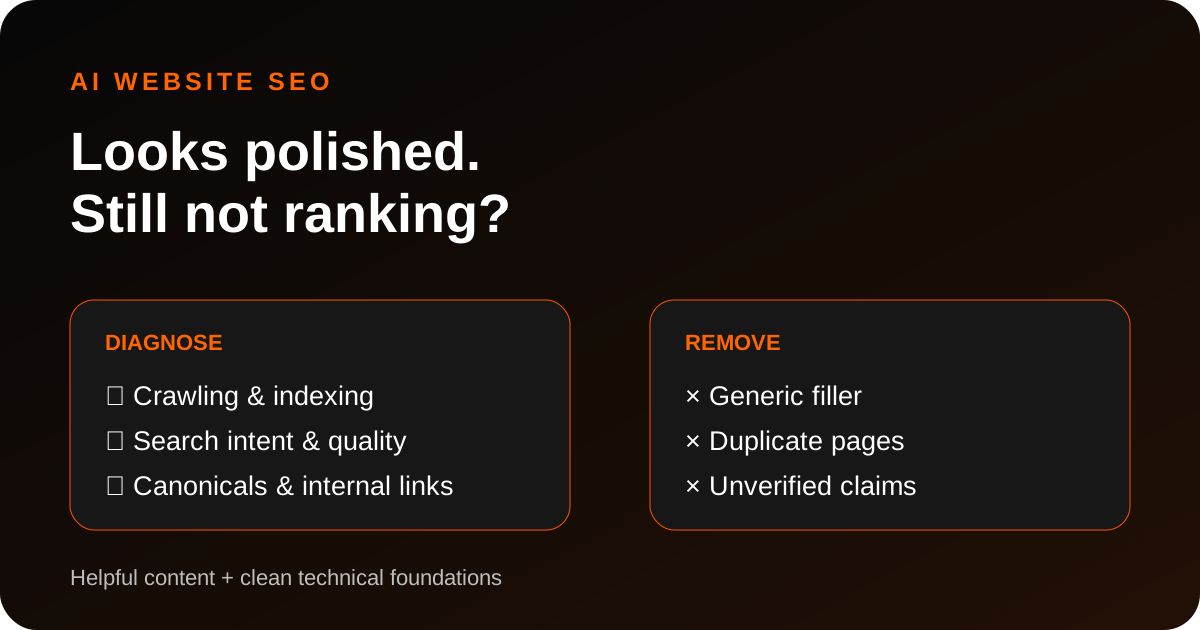
Quick answer: Google focuses on helpful, reliable, people-first content—not whether a human typed every line. AI-built sites fail when they publish generic pages, hide content behind JavaScript, repeat copy, miss search intent or provide no evidence.
A polished AI website can launch in hours and remain invisible for months. Separate the problem into discovery, indexing, relevance, quality, authority and user experience.
1. Confirm Google can find the page
- Inspect the exact canonical URL in Search Console.
- Check robots.txt and meta robots.
- Confirm a clean 200 response and crawlable internal links.
- Include the canonical URL in the XML sitemap.
- Verify important copy exists in rendered HTML.
2. Match one real search problem
Give each page one purpose. A service page should explain who it is for, the problem solved, process, limitations, proof and next step. Use a unique title, description and H1. Do not clone pages and change only a city keyword.
3. Replace generic copy with evidence
| Weak output | Useful replacement |
|---|---|
| “Innovative solutions” | Exact service, deliverables and fit |
| Unverified superlatives | Real screenshots, examples and limits |
| FAQ filler | Questions customers ask before buying |
| Keyword paragraphs | Short sections solving one decision |
Google’s people-first content guidance and SEO Starter Guide recommend unique, useful and well-organised content. There is no magic word count.
4. Build technical foundations
- Correct canonicals and no duplicate route versions.
- Descriptive internal links between services, proof and guides.
- Structured data that matches visible content.
- Optimised images with useful alt text and dimensions.
- Fast mobile rendering, usable buttons and no overflow.
- Analytics, Search Console and conversion tracking.
MaxLeadz builds custom-coded, AI-assisted SEO websites with human review for content structure, schema, sitemap, mobile UX, speed and conversion tracking. The aim is a measurable foundation, not a “100% SEO” ranking promise.
Repair sequence
- Inspect indexing and canonicals.
- Map one intent to each important page.
- Remove duplicates and filler.
- Add real proof and authorship.
- Improve mobile speed and navigation.
- Connect internal links and valid schema.
- Request indexing, then monitor queries.
Related guides
FAQs
Does Google penalise all AI content?
No. The issue is whether content is helpful, reliable and made primarily for people.
Will a sitemap make every page rank?
No. It helps discovery but does not guarantee indexing or rankings.
How fast can SEO improve?
Some fixes are crawled quickly; meaningful ranking changes often need more time and authority.
Want the website repaired instead of rewritten blindly?
MaxLeadz can audit or rebuild your AI website with custom code, technical SEO, structured content and conversion tracking.